That which you Manifest is before You

You should shine with all your light all of the time

Garth Stein, The Art of Racing in the Rain, (2008)

In simplistic terms The Art of Racing in the Rain is a story told from the perspective of Enzo a Labrador owned by a prospective race car driver (Denny Swift). However, the beauty of the story and the writing is the emotive nature of such an innocent perspective observing the raw trials and tribulations of life. Lessons of compassion, persistence and drive can all be found within this wonderful book. Enmeshed in the racing analogies and metaphors are pertinent life lessons that could put to shame some of the self-help or motivational books that exist in the market – all from Enzo’s perspective.

The book has since been translated to the screen. Having now read the book before and after watching the film I have to say that the book is a much more raw presentation of the roller coaster of life. While the satisfaction of seeing Enzo’s perspective presented on film is positive I believe the truly emotive nature of the story is contained within the pages of the book. Both mediums do though take you through the ups and downs of Denny’s life but the book is much more emphatic in doing so.

The premise of Denny’s racing career is that he is incredibly effective in the rain. This not only informs the title of the book but also so many of the analogies and metaphors.

The art of racing in the rain is looking ahead and being intentional in what you manifest. While others may get scared because of the rain you can retain control and by being in control, manifest what is before you.

“Rain amplifies your mistakes, and water on the track can make your car handle unpredictably. When something unpredictable happens you have to react to it; if you’re reacting at speed, you’re reacting too late.”

As a racing metaphor for life, this is really a message of controlling the controllable. This is part of Denny explaining the line “that which you manifest is before you.” As an often repeated line in the book it returns to this life lesson that being accountable and in control of your own decisions puts you in a position of control regardless of the environment around you.

Further development on this can be seen in Enzo’s perspective that by owning what he manifests he can influence those around him. If you were to be positive in how you undertake tasks or actions you may bring positivity to those around you.

I alone, could manifest a change in that which was around me. By changing my mood, my energy.

One of the benefits of Stein writing from the perspective of a dog is the emphasis on non-verbal communication. The sections describing how Enzo wishes he could speak on the situation, or how his limits of verbal expression allow him to actively listen to others are brilliantly written elements on the complexities of interaction. Many pet owners will likely have wondered what their pet was thinking, or would have said in certain situations, perhaps Stein offers an insight into what this would look like.

Other inspirational and motivational messages often come from this innocent non-human perspective and largely concentrate on how to live your best life. While much of the messages may match with cliched sayings the story, and its different perspective separates them from the traditional sources of inspirational or motivational messages. Taking lessons for life from a dog may not be what you expected from reading a book but The Art of Racing in the Rain provides this opportunity all within an emotive and beautifully crafted story.

To live every day as if it had been stolen from death, that is how I would like to live…to say I am alive, I am wonderful, I am. I am. That is something to aspire to.

I would wholeheartedly recommend this book to anyone and if you enjoy it then watching the movie is also a fun experience (definitely because of the adorable dog) despite its more watered down story.

So you think you are a Connector?

The three types of people, Gladwell identified as part of Tipping Point was an interesting element of the book to me. I said I would post the tests or indicators of what type of person you may be.

Firstly connectors, as Gladwell makes obvious these are people that know a lot of people. Not necessarily knowing them all well but identified as ‘masters of the weak tie’. Gladwell created the test for connectors using random surnames taken from the Manhattan phone book. Going down the list of names give yourself a point each time you see a surname shared by someone you know. Stipulations; ‘knowing’ is very broad, even the smallest interactions count, multiple names also count. The score would roughly represent how social you are.

Algazi, Alvarez, Alpsrn, Ametrano, Andrews, Aran, Arnstein, Ashford, Bailey, Bailout, Bamberger, Baptists, Barr, Barrows, Baskcrville, Bassiri, Bell, Bokgese, Brandao. Bravo, Brooke, Brightman, Billy, Blau, Bohen, Bohn, Borsuk, Brendle, Butler, Calle, Cantwcll, Carrel, Chinlund, Cirker, Cohen, Collas, Couch, Callegher, Calcaterra, Cook, Carey, Cassell, Chen, Chung, Clarke, Cohn, Carton, Crowley, Curbelo, Dellamanna, Diaz, Dirar, Duncan, Dagostino, Delakas, Dillon, Donaghey, Daly, Dawson, Edery, Ellis, Elliott, Eastman, Easton,
Famous, Fermin, Fialco, Finklestein, Farber, Falkin, Feinman, Friedman, Gardner, Gelpi, Glascock, Grandfield, Greenbaum, Greenwood, Gruber, Garil, Goff, Gladwell, Greenup, Gannon, Ganshaw, Garcia, Gennis, Gerard, Gerickc, Gilbert, Glassman, Glazer, Gomendio, Gonzalez, Greenstcin, Guglielmo, Gurman, Hoskins, Hussein, Hamm, Mardwick, Harrcll, Hauptman, Hawkins, Henderson, Flayman, Hibara, Hehmann, Herbst, Hedges, Hogan, Hoffman, Horowitz, Hsu, Huber, Ikiz, Jarosehy, Johann, Jacobs, Jara, Johnson,
Kassel, Keegan, Kuroda, Kavanau, Keller, Kevill, Kiew, Kimbrough, Kline, Kossoff, Kotzitzky, Kahn, Kiesler, Kosser, Korte, Leibowitz, Lin, Liu, Lowrance, Lundh, Laux, Leifer, Leung, Levine, Leiw, Lockwood, Logrono, Lohnes, Lowet, Laber, Leonardi, Marten, McLean, Michaels, Miranda, Moy, Marin, Muir, Murphy, Marodon, Matos, Mendoza, Muraki, Neck, Needham, Noboa, Null, O’Flynn, O’Neill, Orlowski, Perkins, Pieper, Pierre, Pons, Pruska, Paulino, Popper, Potter, Purpura, Palma, Perez, Portocarrero, Punwasi, Rader, Rankin, Ray, Reyes, Richardson, Ritier, Roos, Rose, Rosenfeld, Roth, Rutherford, Rustin, Ramos, Regan, Reisman, Renkert, Roberts, Rowan, Rene, Rosario, Rothbart, Saperstein, Schoenbrod, Schwod, Sears, Staiosky, Sutphen, Sheehy, Silverton, Silverman, Silverstein, Sklar, Sioikin, Speros, Stollman, Sadowski, Schles, Shapiro, Sigdel, Snow, Spencer, Sieinkol, Stewart, Stires, Stopnik, Stonehill, Tayss, Tilney, Temple, Torfield,
Townsend, Trimpin, Turchin, Villa, Vasillov, Voda, Waring, Weber, Weinstein, Wang, Wegimont, Weed, Weishaus.

The highest score recorded in the book was 118, in my opinion this is an interesting exercise and may indicate a propensity to be a connector. The test is relative however, older people likely have more connections, but the conclusion was that in every circle of life there are people who have much larger social circles and these are the connectors.

As a comparison when Gladwell gave this to students in a class he was teaching the average score was 21.

For the Mavens

Mavens were not identified with a specific test but are those differentiated from the people centric ‘connectors’ as ‘information specialists’. Ultimately they just like information and want to share it with others. They are not the persuasive type like Salesmen but collect a varied information database that means they are the type of person that others go to for advice. Often Mavens will go out of their way to help. A simplified post differentiating between these three types can be found here.

In this other article five questions were asked which I find to be symbolic of potential habits of a Maven.

  • Do you enjoy reading junkmail?
  • Do you seek out the specials in your local supermarket?
  • Do you tend to watch trends and know what’s in?
  • Do you study the market before buying a new gadget?
  • Do you tell your friends about special deals?

These are indicators and if you find yourself saying ‘yes’ to the majority of the questions then this would indicate Maven tendencies.

Selling, Selling, Sold

Salesmen are perhaps the most easily understood of the three. Simply, these are the charismatic individuals that can quickly build a rapport and trust that allows them to sell things. Gladwell puts this down to their ability to express emotions and feelings.

In the book Gladwell discusses the Affective Communication Test created by Howard Friedman with information linked here. While not available online, the test effectively measures the aforementioned ability to express emotion and make others feel it. Gladwell presents this ability as a contagious quality that means an effective salesperson will make others fall in line with how they feel. If a salesperson is happy and excited you would likely follow suit.

The lifehack post previously linked also stated 5 questions that can indicate salesperson tendencies.

  • Do you find it difficult to sit still when hearing good dance music?
  • Do you have a loud laugh?
  • Do you touch friends when you talk with them?
  • Are you good at seduction?
  • Do you like being the center of attention?

Again not a flawless list of questions but for an effective salesperson, I believe they would already be largely aware of, or have been recognized as this type of person.


This is just an interesting element of Tipping Point and shows the unique roles that different people can play within their social circles. Identifying those people within your own circle is also an interesting process as I am sure that you will find each of these types of individuals.

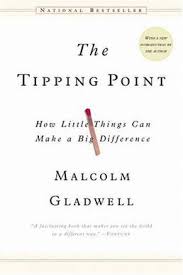
How Little Things can make a Big Difference

Malcolm Gladwell, The Tipping Point (2002), ISBN 978-0-316-34662-7

The Tipping Point is that magic moment when an idea, trend, or social behavior crosses a threshold, tips, and spreads like wildfire.

Malcolm Gladwell, The Tipping Point (2002)

The peculiar fragility of an epidemic is fascinating given the particular mixture of factors that can cause them. Gladwell presents ‘little things’ being triggers for much greater epidemics. New York crime is taken as a significant example, Gladwell asserts that when looking to solve this epidemic police chiefs and other authority figures looked at “Broken Windows” theory. This theory created by criminologists James Wilson and George Kelling argued that crime inevitably resulted from disorder.

If a window is broken and left unrepaired, people walking by will conclude that no one cares and no one is in charge.

The Tipping Point, p.141

The resolution of this theory elevates seemingly little things into key factors in both creating and resolving epidemics. Gladwell places this under the Power of Context, just one of the elements that creates epidemics. This kind of relationship can be observed in the recent Joker movie and the breakdown of social order. Fixing the small things such as graffiti on the subway and broken windows correlated with a drastic reduction in crime statistics in New York.

The Law of the Few

A larger focus of Tipping Point are the people that transform social epidemics. Gladwell states that three types of people are essential to create ‘tipping points’.

https://i.pinimg.com/originals/92/2c/0e/922c0eea05705c5938fb49a3bb43a8e0.jpg

Connectors

“These people who link us up with the world…who introduce us to our social circles…Connectors, people with a special gift for bringing the world together.”

Mavens

“The word Maven comes from the Yiddish, and it means one who accumulates knowledge.”

Salespeople

People with “the skills to persuade us when we are unconvinced of what we are hearing”.

These three types of people, Gladwell classifies under the ‘Law of the Few’, effectively epidemics or viral moments occur as a result of the actions of these types of people. So as part of the Tipping Point there needs to be one of these types of person as well as the right context.

In a social epidemic, Mavens are data banks. They provide the message. Connectors are social glue: they spread it. But there is also a select group of people – Salesmen/Saleswomen – with the skills to persuade us when we are unconvinced of what we are hearing, and they are as critical to the tipping of word-of-mouth epidemics as the other two groups.

The Tipping Point, p.70

Following discussion of the people Gladwell moves onto the message of the epidemic. In this he addresses ‘The Stickiness Factor’. In addressing this third factor, Gladwell uses the case of Sesame Street, in it he covers the evolution of the show and how it aimed to make education a mainstream show for children that retained their interest. As with all things, the narrative evolves gradually as more data and understanding is created and Blues Clues is introduced as a form of continuation of this trend. In both shows described, the stickiness factor was invoked in how attention was drawn to specific elements of episodes and how the show encouraged viewers to not only continue watching one episode but a series.

The Stickiness Factor effectively governs how well a message will be retained by the receiver. Returning to the understanding of how to go viral/create a social epidemic the list would effectively entail three steps.

  • The Power of Context: The message must fit within the societal trends of the moment. (The idea of clickbait articles hinging on current trends for example!)
  • The Law of the Few: If you were wishing to spread a message or idea, the need for a connector, maven, salesperson or a mix of all three would be essential. All three have the ability to spread the message into their extensive networks.
  • The Stickiness Factor: Has your message or idea got enough to grab and keep an audiences attention?

Tipping Point is as fascinating for the psychology data driven evidence and conclusions as it is for the case studies used. Think of one hit wonders or companies that shot to fame just to fall as quickly. All these examples had at one point all three aspects of Gladwells factors operating in collaboration before a crucial element failed to hold its position. Often the Stickiness Factor seems to be the first to go, a company is cool and innovative until it no longer continues to innovate. An accessory or item is trendy or hip until it reaches mainstream adoption and then suddenly it loses its appeal.

Gladwell does a fantastic job of illustrating factors that create epidemics both positive and negative examples. Furthermore, it is fascinating to learn about the various psychological studies that suggest how susceptible we all are to environment and conditioning. It is also interesting to consider correlation between epidemics such as sexual disease epidemics and the season of the year for example. These relationships make sense when logically observed but would rarely be considered otherwise.

He also considers other elements of social function such as Dunbar’s number/150 rule which should be interesting reading if you want to learn more about cognitive limits. Ultimately this book is as much about how society functions and human interaction as it is about the epidemics that these functions generate.

As the title of the book suggests, this really is a pertinent example of how ‘Little Things’ can make a ‘Big Difference’. The conclusions are relevant in all facets of life. Consider how throwing trash on the floor may then make someone else less likely to throw their trash in the garbage, this feeds the message of The Tipping Point. The book has so many interesting elements that it is impossible to truly encapsulate all the aspects it depicts. Now there are studies that go someway to disprove some the conclusions that Gladwell reaches but the book is well written and offers a great stepping stone for delving deeper into the field.

This book like The Alchemist last week is another worldwide best seller and it is clear to me why. I would heavily recommend this book if you are into psychology but as suggested it is also interesting to learn about real examples of how these lessons have been developed. I have not gone into too much detail as the joy would be found in reading about the various examples for yourself. However, there will be a midweek post about the various tests used to determine whether you are a connector, maven or salesperson and it is worth noting that these are not exclusive.

As the next post will be in February, I will be focusing on fiction books as part of “Fiction February”. This will also use books that may have been adapted into film. As always, keep up to date on upcoming books on the book list page as it will be updated regularly.

Cheers!

Manifesting your Personal Legend

Paulo Coelho, The Alchemist (1993), ISBN 978-0-06-112241-5

Will Smith’s favorite book of all time, The Alchemist is an exquisite parable and story. If you have not had the pleasure of reading the book then do, if you have already read Santiago’s tale then re-read it. The story aside, the lessons and teachings in between the lines can touch all aspects of someone’s life. This is perhaps the greatest beauty of The Alchemist. Not only are the teachings so powerful but they can also be deeply personal. Personally, on the second time reading, I found completely different aspects just as interesting as other elements that I identified the first time through. This is perhaps indicative of the deeply personal ‘Language of the World’ that Coelho weaves throughout Santiago’s journey.

The Alchemist is a story about realizing a Personal Legend. In equal parts, spiritual and mystical the journey depicted offers lessons for any reader of any religion and disposition. The book also provides an inordinate amount of clichés. Clichés to me though are statements that only make sense once you have experienced them, for example, love clichés that can only be understood once you have truly been in love or parents sayings and actions that only make the most sense once you yourself have children. Similarly, as Santiago learns, it is only through the journey itself that you learn everything you need to know.

From Goodreads

You have got to find the treasure, so that everything you have learned along the way can make sense.

The Alchemist, p.116

The Alchemist is so utterly quotable that this post could simply have been a collection of the best citations. I also do not want to ruin the story by giving away details of Santiago’s journey. Nevertheless, the best takeaways from the book are lessons that can be applied to life just as much as they are relevant to the Personal Legend of Santiago within the story.

It is no surprise The Alchemist is Will Smith’s favorite book, it preaches the values of manifesting your own dreams and chasing them. Perhaps one of the most iconic quotations that can be taken from the book is that:

From Goodreads

When you want something, all the universe conspires to help you achieve it.

However, more than this it also preaches the virtues of acting without fear and overcoming obstacles.

There is only one way to learn… It is through action. Everything you need to know you have learned through your journey.

The story focuses on finding treasure but as seen it is the journey to it in which the true treasure is found. Every person has a unique and beautiful Personal Legend and it through action that this can be realized. The Alchemist is full of the idea of following your heart and perhaps if your heart is seemingly pushing you away from something consider that, ‘naturally it is afraid in pursuing your dream, you might lose everything you have won’ but that ‘you will never be able to escape from your heart. So its better to listen to what it has to say.’

Wherever your heart is, that is where you’ll find your treasure

The Alchemist, p.128

Rather than worrying about the future, Santiago’s journey teaches that the fear of suffering is much worse than the suffering itself.

If you pay attention to the present, you can improve it. And if you improve on the present, what comes later will also be better.

The Alchemist, p.103

Perhaps you have difficult decisions ahead, this story preaches that this is simply another obstacle on the path to reaching your treasure and achieving your Personal Legend. When you look back at the most difficult or stressful periods of your life how often do these become part of your own personal narrative? Ultimately if everyone was to give up when the journey got tough then no one would ever truly reach their dreams. Take chances when they come up, follow your heart, ‘every blessing ignored becomes a curse’.

It’s the possibility of having a dream come true that makes life interesting.

Paulo Coelho, The Alchemist, p.11

Cheers, and here is to more people achieving their Personal Legend in 2020. (Make reading The Alchemist a priority!!)

As always feedback and comments are much appreciated, look forward to another popular book next week in Tipping Point by Malcolm Gladwell.

Coming Soon to TWBR

Firstly, thank you to those who read the first report on Inequality and the 1%. You can read it here if you missed it. The book itself provided much more than I had the chance to include in the post as it provides a significant foundation for a wider understanding of the environment it discusses. The book is widely available for purchase and has its own page on the authors website here.

Coming up next is a report on the world famous The Alchemist by Paulo Coelho, as a novel that I found personally fascinating the first time I read it I can not wait to write up some of my thoughts. The post will hopefully go up on Sunday 10:30 (ET). It will divert from the manner of Inequality and the 1% mostly due to the different subject matter and content. However, it is another book that I would wholeheartedly recommend.


If you venture to the “Book List” page then you will find an update for week 3 being The Tipping Point by Malcolm Gladwell. As another bestseller, many may have had the privilege of reading it but the lesson of ‘How Little Things can make a Big Difference’ will be a lesson that can also be applied in approaching The Alchemist and life more generally.


All that is to come over the next fortnight and I hope that these books will interest many visitors to the page.

I hope everyone has had a wonderful start to the New Year.

Cheers!

Week 1 Book Report

Inequality and the 1%

Danny Dorling, Inequality and the 1%, Verso (2015) – ISBN 978-1-78478-207-8

Welcome to the first week of “The Weekly Book Report”, please appreciate that as the first post this will be the inaugural attempt to find the correct tone for these posts, so please bare with me. Anyway here goes.

In the world of inequality, the phrase “the rich get richer and the poor get poorer” is commonly cited, in addition to Scandinavian countries such as Finland being held up as a veritable utopia for social welfare and equity. Inequality and the 1% regularly addresses these tropes with the dominance of Scandinavia in equality being a regular conclusion in the variety of structures Dorling addresses. While largely focused on the US and UK, the book still emphatically argues for the wider hinderances that inequality can create in the pursuit of more equitable global prosperity.

Inequality is more than just economics – it is the culture that divides and makes social mobility so painful, both for those dropping down the income and wealth scales and for those going up.”

Inequality and the 1%, p.24

The book is organized around the structures that can aid the entrenchment of the 1%, namely, childhood, work, wealth and health. The angry style Dorling employs in Inequality and the 1% is not unreasonable at points but some significant considerations do need to be made. Being part of the 1% may consciously or unconsciously be a goal for some, a position from which helping the local community is possible and lastly a status that comes with significant achievement in some profession or interest. Inequality and the 1% largely sees this elite group as in some ways the sole active perpetrator of inequality in Anglo-American culture.

Childhood

Concerning education and childhood Dorling points to the wealthy not only paying significantly more for private education but subsequently also seeking a reduction of their funding toward the state education that they begin to see as sub par. Citing the example of parents bidding thousands of pounds for unpaid internships for their child is just one way in which the path to the 1% is kept within a specific community. Children in families within the 1% benefit substantially from their situation and this often serves to widen the gap to the 99%. The state that Dorling presents is an overwhelming pessimistic one in which parents effectively pay for their children to be trained as a member of the 1%.

Work and Wealth

This section flows smoothly from the factors addressed in childhood. A notable takeaway from this section being the insular nature of the 1%. Ideas that Dorling address inevitably lead into the section on wealth.

By 2012 the best off tenth in the US were taking over half of all personal income…by one estimate, the top 1 per cent saw its take rise to 22.5% of the national total.”

Inequality and the 1%, p.57

Income alone does not guarantee a consistent presence in the 1%. The truly super rich are often not just those with substantial incomes but also with historic assets and contacts and know-how that allows them to protect and hide such wealth. What is regularly noted though and is always a shocking statistic is the income inequality. However, this is not the only problem in inequality generally and should not be presented as such (Dorling does not fall into this trap which is to his credit).

Health

I won’t spend much time on this section, it is an interesting chapter but the correlation between wealth and better health to me at least seemed relatively common sense. Dorling points these out with ample evidence, notably that the lack of stresses of survival on lower salaries is just the foundation for the wider divide, that treatments, activities and healthcare can be more easily afforded simply extends this inequality.

Interestingly though recent studies have shown that this is the first generation of children in which those from the richer families in society have lower rates of obesity than the poor.

(This is part of an interesting historic narrative of a transition from nobility’s extravagant consumption, with obesity related diseases such as gout having been seen as a symbol of wealth)

Perspective Piece

Inequality and the 1% is fascinating as it provides ample evidence to support the conclusion that the 1% needs to have their influence curtailed. Dorling also highlights that the 1% is becoming increasingly stratified and this stratification is much more pronounced than toward the 99%. Effectively the book is less about the 1% and actually about the super rich (the 0.1/0.01%).

All the rich are doing very nicely, but since 2011 the divisions within the richest have been widening.”

Inequality and the 1%, p.91

With the current political climate there have been many questions that have arisen toward the treatment and existence of the superrich as well as the largest of companies. It is worth noting that personally I do believe that these individuals and companies should be held accountable. In a simplified understanding such staunch inequality should not exist, and taxes were a small way to attempt to rectify this. Financially much more needs to be done but in the other facets of life, more tolerance and understanding needs to take place, as harmful as the 1% and increasingly the top 0.1% can be financially, it is the insular nature of the community that leads to deeper social problems.

There may be a couple of posts over the next week about specific parts of this book that were interesting but for now, I hope you enjoyed the first report and look forward to the second week with the book linked on the “Book List” page.

Cheers, and as always feedback is much appreciated.

Introduction: TWBR

This simple blog “The Weekly Book Report” (TWBR) will be exactly what it claims to be. Part of the idea is to increase the number of books I read and hold me personally accountable in some fashion. Another part is creating a record of those books and the elements of interest within.

With both of these objectives the benefits can be both personal and to any visitors of TWBR. Hopefully the reports will offer a review of sorts as well as dissemination of interesting information.

While the majority of books selected will be the result of personal interest, I will also endeavor to create possible thematic links between different reports. Other relative news or updates will also be posted.

Cheers, here is to a wonderful 2020

Create your own website, free on WordPress.com.Create your own website.
Start free