
Richard Connell, The Most Dangerous Game (1924)
The Most Dangerous Game recently entered the public domain. It has been the most interesting and compelling short story I have read up to this point in the year. The premise of hunting the most dangerous animal (humans) is clearly inviting enough for a modernized Quibi digital adaptation. Reading through this short story it is certainly possible to see the potential that it could be drawn out to a full novel length work. The 15 episode Quibi adaptation certainly seems to be representative of this concept, however, the short, snappy and action packed story makes this an easy and engrossing read.
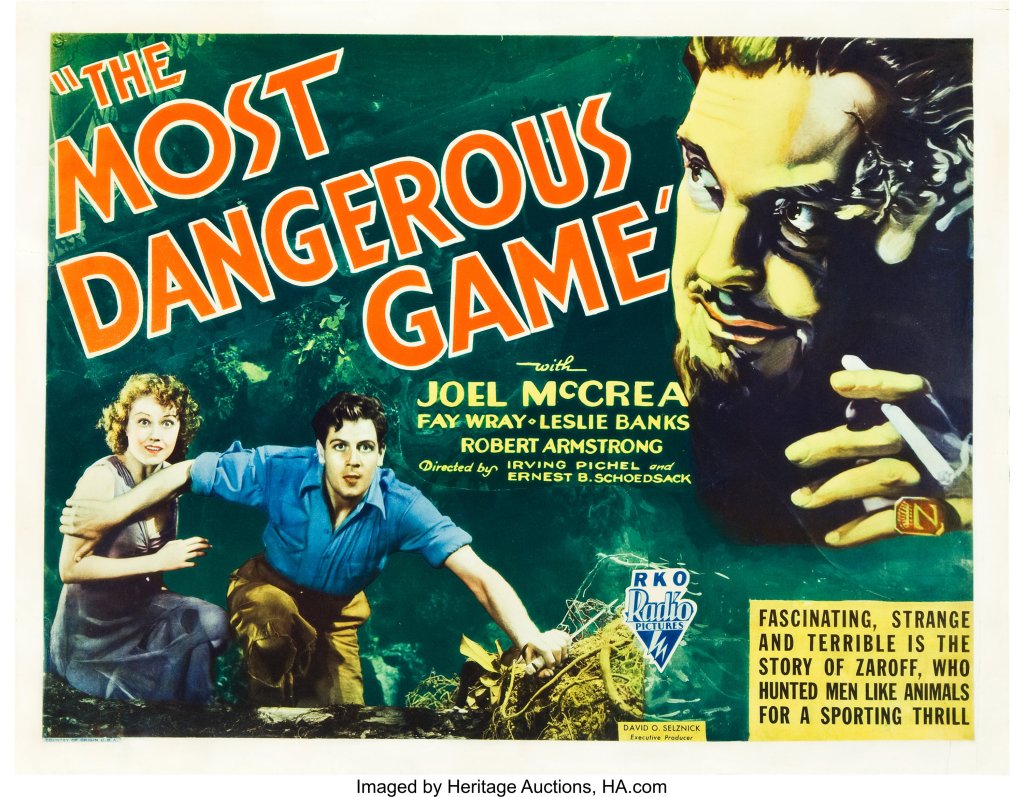
The short story will evoke images of other shows and novels with the tropical island, eccentric villain and battle of wits. The fact all this takes place in a short digestible story is partially the reason for its popularity. It won the O. Henry Memorial Award for short fiction in the year of its publication (1924).
The story starts with Sanger Rainsford landing on the island and being amazed as he wanders into the estate of General Zaroff. The conversation about the most dangerous game is a fascinating exchange as Rainsford gradually realizes the true nature of the generals hunting.

“But no animal can reason,” objected Rainsford.
“My dear fellow,” said the general, “there is one that can.”
“But you can’t mean–” gasped Rainsford.
“And why not?”
“I can’t believe you are serious, General Zaroff. This is a grisly joke.”
“Why should I not be serious? I am speaking of hunting.”
“Hunting? Great guns, General Zaroff, what you speak of is murder.”
The story is set up almost in three sections; the introduction of Sanger Rainsford and his arrival on the island, his meeting with General Zaroff and the establishment of the stories premise, and then the hunt. As consistently suggested the story does not take time in vivid descriptions or extensive contextualization but it is very evenly paced given the significance of the final section. The scenario of the hunt is effectively a high stakes (life or death) battle of the wits but in a highly unbalanced power dynamic of hunter and hunted. One of the most gripping sections of the story are Rainsford’s attempts at slightly reversing this power dynamic. The hunt this time takes a different path to the normal victims of General Zaroff’s game as both Rainsford and Zaroff are well matched in wit and knowledge.
While the hunts conclusion would seem to be the right point to finish Connell adds a characteristically concise addition. A conclusion which suggests that in this case the game is not over until the hunter or hunted ends up dead. While the story itself is not difficult to follow, there is considerable room for analysis. Perhaps foreshadowing the conclusion Rainsford notes to his assistant before he falls from the ship and swims to ‘Ship-Trap Island’, “The world is made up of two classes–the hunters and the huntees. Luckily, you and I are hunters.”
The Most Dangerous Game would make a great story to analyse in an English class. The discussion of humans as the most dangerous game and the precarious hunter and hunted dynamic drive the plot. It is a plot that compels the reader to continue reading and given the short punchy nature of the story it is not difficult to find yourself at the end quickly. There are intriguing narrative sections scattered with profound thoughts and expressions. Now this story is available in the public domain it is freely accessible to all and should be high up on any readers list given you could get through it in an afternoon.
Find The Most Dangerous Game here.
 The Weekly Book Report
So glad you read this! Thank you for your dazzling insight into this thrilling tale.
LikeLiked by 1 person