
Lewis Hyde, The Gift: Imagination and the Erotic Life of Property (1983) – Updated in 2007 as The Gift: Creativity and the Artist in the Modern World
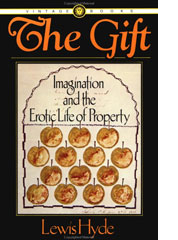

Lewis Hyde’s The Gift has gone through a couple of subtitle changes but remains a foundational text in understanding the etymology of gifts and generosity. Each chapter addresses a different societal function or environment of gifts and highlights how ubiquitous the phenomenon of gift giving is throughout all communities. Hyde’s work relies on anthropological studies as much as it does on folklore and stories to highlight what a gift relationship entails. Personally it was interesting and revealing to start with but eventually got to a point where the essential arguments were simply being restated with a different example or situation. If the topic is interesting to a reader then this is an essential reading otherwise the early chapters and introduction serve a better educational purpose. It is considered a modern classic after an initial publication in 1983 with the 25th anniversary edition titled The Gift: Creativity and the Artist in the Modern World, this in comparison to the original The Gift: Imagination and the Erotic Life of Property. The British version titled The Gift: How the Creative Spirit Transforms the World, further information on these versions can be found here. Perhaps these titles can indicate a little of the sort of content that The Gift generally contains, specifically the idea of creative spirit and the idea of a divine gift that artists, performers and high achievers are considered to have.
The idea of an individual being gifted was the most compelling area of the book for me. The consideration that a gift is something that needs to be used and remain in consistent motion might not seem immediately relevant to a gifted individual but when considered more deeply Hyde makes it clear how this can be thought about.
First it is important to consider more traditional forms of gift and separating it from commodity exchange that dominates the market. Hyde suggests gifts are not governed by value but worth since many gifts have emotional or spiritual meaning invested in them. Take for example a family heirloom or a gift made for someone else in need. For someone hungry a gift of food will be far more meaningful than if they scraped together money and bought some food. The food may have the same value but far different worth.
There are several distinct senses of “gift” behind these ideas, but common to each of them is the notion that a gift is a thing we do not get by our own efforts. We cannot buy it; we cannot acquire it through an act of will. It is bestowed upon us. Thus we rightly speak of “talent” as a “gift,” for although a talent can be perfected through an effort of the will, no effort in the world can cause its initial appearance. Mozart, composing on the harpsichord at the age of four, had a gift.
p.xi-p.xii
The quotation above touches on the essential learning from The Gift that a gift does not need to just be a physical item and there is often an innate gift/talent.

However, the first chapter considers one of the most common gifts, that of food, with Thanksgiving next week this is relevant. Food is given as a gift and if it is not consumed it is sometimes seen as offensive to the gift giver. In addition, the gift giver is not assured of reciprocity which is a key element of gift giving in general. The gift can be passed on when the receiver later themselves gives food to others or another form of gift. A gift exchange can be between just two people but often becomes more circular.
The gift that is not used will be lost, while the one that is passed along remains abundant.
p.22
A gift can be wasted in many senses and when the base level sees life as a gift then it is clear how this can be extrapolated to many areas. Food given as a gift that is then not consumed is wasted, a family heirloom that is pawned off is no longer a gift, and an innate ability to create beautiful art is a gift wasted if the artist fails to pursue their talent. In so many ways gifts can be wasted, Hyde comprehensively addresses what form a gift can take as well as how gifts are received or given.
In a continuation of the idea of worth against value there is also a consideration of labor and work. The third chapter for me was incredibly interesting because of this consideration. There is a presentation of the idea that industrialization has expanded work at the expense of labor. The turn of phrase, labor of love perhaps explains the key difference between labor and work. Work is the daily job while labor is in pursuit of talent or a gift. It is possible that one can influence the other positively but it is presented in such a way that one comes at the cost of the other.
The other chapters consider when gifts are given, such as transformational times or at points of change in life, or how gifts create closer communities and potentially strengthen relationships. The bond that gifts create is such a foundational aspect of gifts that every chapter covers an element of this relationship. While gifts are given without an assurance of reciprocity there is an understanding that it would be passed on or reciprocated eventually. In small communities gifts can be passed around and effectively bring everyone together through the bonds the exchanges create.
As suggested, The Gift is essential for understanding the etymology of gift giving and generosity and comprehensively addresses various aspects of both the gift and its resulting relationship. Hyde also offers a useful historical and anthropological background on small community studies related to gift circles and it offers a fascinating insight into the positive implications of generosity and gift giving at large. The book is repetitive at times and has certain sections that are of more interest to particular readers but is important for the subject area.
 The Weekly Book Report