
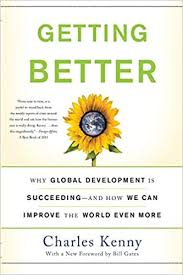
Charles Kenny, Getting Better: Why Global Development is Succeeding – And How We Can Improve the World Even More, Basic Books (2012)
Kenny’s intention with this book is to largely address an increasingly and ever present cynicism around international development. The issues surround Western dominated largely supply led initiatives that are seen to fail providing meaningful and long term sustainable development in developing nations. My main conclusion around this matter is that rarely is anything black and white, if international development or other areas of endeavor to improve the global human situation are viewed as such then the nuances that demonstrate success are obscured by an overwhelming sense of despair and futility.
Ultimately there is a troubled past in international development and the hierarchical power structures that dominate programs and projects has created a number of situations that hindered development. However, as Kenny gets to in his book there are other areas in which developing nations have truly seen progress in the quality of life for citizens. Again though, is this a result of intentional development policies or just an inevitable part of human progress?
The early chapters of this book are devoted to the bad and worse news for international development. Despite this they are tinged throughout with indicators of the direction the rest of the book takes. These indicators largely take the form of identifying the limitations of traditional measures and claiming it limits the negative implications around global development. This premise is established in chapter 2 which discusses ‘Diverging Incomes’ as bad news and is followed with the worse news of chapter 3 and ‘It’s Hard to Raise Growth Rates’. The essential problem that Kenny identifies is that utilizing income as a measure of global development success or failure is too reductive in its assessment of the development and quality of life in developing countries.
This leads to comparisons of estimated GDP measures between mid 19th century England and some Sub-Saharan African nations. While possibly at similar levels in income measures they are incomparable when looking at technology, life expectancy and other quality of life measures. This forms part of a conclusion that diffusion of technology and modern innovations are a much more significant indicator of global development success. It is difficult to argue with aspects of Kenny’s suggestion given that widespread technology has allowed people all over the globe to be more connected and healthcare to become increasingly affordable. An indicator used is infant mortality rate, nations in the mid-19th century that had comparable GDP rates to developing nations in the modern day, had much higher infant mortality rates than their modern comparisons. Kenny takes this to indicate the successes of global development.
However, while I came to conclude that there have indeed been substantial successes of global development as suggested with my statement in the opening paragraph, the problem has shifted to an inequity within development. Technological development is still lacking in developing countries and it is arguable whether a majority of the development seen is actually the result of intentional programs. While innovations available to citizens of developing nations may have been received as magic or witchcraft to the mid-19th century individuals who saw similar GDP levels in now developed countries, I do not think this necessarily marks a huge success of global development. Kenny does though make the key conclusion that more successful programs need to rely on the input of local communities and be more flexible. A supply led model does not lead to sustainable success it is rather a process of collaboration that allows local deployment of resources in addressing systemic problems. To use a commonly cited example, the Soviets providing tractors to Ethiopian farmers did not revolutionize agriculture largely due to a lack of infrastructure and training that just left the machines rusting in fields. Addressing structures and education have left much more significant development achievements than more direct programming such as road building or tractor provision. You may think that building roads will help residents in Kenyan villages travel more easily but what use are such roads if there are no cars? In affect, many development programs have fallen foul of limited initial research and failing to actually meet the needs of residents but met the needs of hypothetical villagers in the minds of Western program leaders.
Kenny suggests three points for future policy:
First, we should be humble – we are unclear as to the record and the reasons for Africa’s successes and failures (this applies as much to the thinkers of the Left as to those of the Right). Second, our view of African states should not be one of contempt for their failure. Only if we use a narrow, partial view of what “success” meant for the people of the continent can “failure” be the verdict without caveat. Given this, the West’s willingness to partner with African governments and African people should be based not on an assumption of unfettered superiority of approach but, instead, on one that recognizes the significant accomplishments of independent Africa to date. Finally, we should be realistic in the goals that we set.
This was a more optimistic outlook on global development than a lot of academics tend to perpetuate but there are undercurrents in Kenny’s sentiment that align with critics while remaining more positive. A consistent theme is that we know relatively little about development policy and approach that truly works. Another aspect being that we are aware that a universal approach most likely does not work effectively. The comparative to the situation in Africa that Kenny addresses extensively is the development in Asian nations such as South Korea and Japan. The situation effectively drew comparisons to the extent that measures taken in East Asian nations could be applied and see comparable success in Africa. We now know this was clearly inaccurate but looking back this is perhaps common sense. No one nation has the same situation and while it is certainly important that development aid and resource support is maintained this should not be undertaken in a manner that seeks to homogenize nations development and curtail cultural identity.
To me, this book offered a positive outlook on global development in a way that made me hopeful. While the past of the sector is mired in difficulty there is a growing consensus that the approaches need to change. Ultimately it is also difficult to ascertain progress when programs and initiatives take years if not decades to see sustainable change. However, this is a book that addresses the nuances and highlights positive elements of global developments. It is not a complete education of the sector but it does a lot to show where positive paths lie, namely in diffusion of technology, and locally led initiatives that actually meet grass roots needs rather than the desires of traditional Western donors and organizations.

Ultimately seen from a very basic perspective I believe everyone and anyone should have access and opportunity to lead a good and healthy life. Helping those less fortunate than oneself is a position of privilege but it is important not to let that privilege cloud how we can collectively help others. If there is a way to help others in developing countries have access to a higher quality of life then that should be a path explored but only if it is done in a comprehensive manner that actually takes into account the communities needs. The assumption that a Western donor knows best what a farmer in Sierra Leone needs is problematic and in case of aid can largely result in more harm than good.
 The Weekly Book Report