
Mark Twain, A Dog’s Tale (1904)

My father was a St. Bernard, my mother was a collie, but I am a Presbyterian.
As a follow up to Eve’s Diary from last week I found A Dog’s Tale another Mark Twain work that went through the same treatment. Originally an entry in Harper’s Magazine it was adapted to book form by Harper & Brothers.
Written from the perspective of an unnamed dog and following its journey the story is both funny and sad in equal measure. The innocence and truncated understanding of the world from a dog’s perspective creates the larger sections of humor. The dog’s treatment by the family that buy her, while mostly good, also creates the space for sadness.
The early chapters address the learning from the dog’s mother with meaningful lessons such as leading by example. It is also fun to read how the dog’s mother was a relative intellectual repeating words and phrases she heard to other dogs and making them feel stupid. This is all the case even though the mother herself does not know the true meanings. The two words specifically mentioned being synonymous and unintellectual, both incorrectly defined.
When the family eventually buys the dog and the two are separated the emotive chapter has another meaningful message.
In memory of me, when there is a time of danger to another do not think of yourself, think of your mother, and do as she would do.
As the opening line points to, there are religious understandings and connotations broached in this story. The chapter addressing the separation of puppy and mother describe the nature of living for the ‘best good of others’. The dog’s mother teaches this value from overhearing these messages from sunday school and in effect emphasizes the dog’s purpose as living for their owners.
The Gray family that the dog is bought by are relatively well off. They have a young daughter as well as a new baby. Mr. Gray is a renowned scientist. The dog receives considerable love from the family other than Mr. Gray, including the servants in the house. The dog learns the ways around the house and a section goes toward this period of learning and acclimatization. After a period of time the dog has a puppy.
The pair are doted over by the family and servants with the story spending time describing the cute and innocent puppy.
The day which shifts the story from innocence and humor to sadness comes when a fire starts in the families nursery. While saving the baby the dog gets beaten by Mr. Gray as he misinterpreted what was happening. This turn of events leads to a large section of sadness and while the family can not find their dog they do not give up and eventually find her hidden away. Now aware of the heroism the dog is treated as such. It was emotional to see the recall of Sadie (the Gray’s daughter) crying out for her dog.
It is when Mrs. Gray, Sadie and the baby leave for a journey that the story winds down to its sad end. It is already clear that Mr. Gray is more of a callous figure, this section solidifies this. Mr. Gray and his friends have a debate about optics and experiment on the dog’s puppy. The callousness of Mr. Gray’s actions make him a villain of this story. The experiment does not end well and the doting love of the dog over her puppy is emotional given the lack of understanding of death. The servants are noted as incredibly upset at the turn of events and juxtapose the treatment and death of the puppy with the dog’s heroism and care in saving the baby.
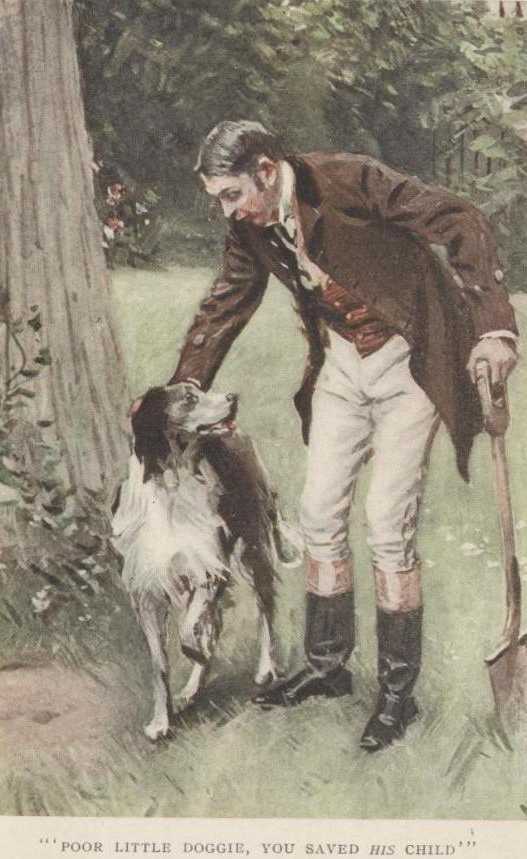
The final lines concern this scenario as the other Gray’s are returning home to both the dog and puppy dead. It is the realization of irony that the dog served dutifully and saved the baby while seeing her own puppy killed that ties the story together. Their is consistent reference to the idea of heaven and animals not going there as they do not possess the same soul as humans. However, in this story the dog’s sacrifice is placed in opposition to the actions of Mr. Gray. The dog will lay by the grave of her puppy until she also passes away.
 The Weekly Book Report