
Wes Moore, The Other Wes Moore, (2011)
“Do you think we’re all just products of our environments?”…
“I think so, or maybe products of our expectations.”
“Others’ expectations of us or our expectations for ourselves?”
“I mean others’ expectations that you take on as your own.”
This particular conversation between the two Wes Moore’s is ultimately the theme of this whole book. Written from the perspective of the Wes Moore who served in the military, became a Rhodes scholar, and a White House fellow this story juxtaposes his own roller coaster of a life with that of identically named Wes Moore who ended up in jail for his role in a robbery and murder. It reduces the significant story of the “Other” Wes Moore to just focus on the ending as his life has many ups and downs that would otherwise be obscured. In some ways this is why the book is so compelling, it is a raw, at times depressing, but also inspirational story. The two men may not on the face of it seem to have much in common if you just judge their position at the end of the story. However, the similarities in their childhood (they grew up in the same Baltimore area less than a couple of blocks away from each other) and circumstances lead to the conclusion that while their paths diverged drastically the endings could easily have be reversed or dramatically different. This is the situation I believe influences the discussion quoted at the beginning of this post. How did the other Wes Moore end up in such a dramatically different situation to the author? If they had much of the same environment growing up, was it indeed expectations that shifted their eventual path? Ultimately the book does not actually answer this but it does offer a relatively complete image of the way events as well as those around oneself can drastically alter the direction of ones life.

This is the story of two boys living in Baltimore with similar histories and an identical name: Wes Moore…Our stories are obviously specific to our two lives, but I hope they will illuminate the crucial inflection points in every life, the sudden moments of decision where our paths diverge and our fates are sealed. It’s unsettling to know how little separates each of us from another life altogether.
Have you ever found yourself wondering what would have happened if you had made a different decision in a certain moment? This book in a way offers a real life example of this thought. Both Wes Moore’s go through immense struggles and the author constructed this book through interviews with his name twin. Together they both show a difficult family environment as well as the challenges of growing up in Baltimore in the 1980s. A racially charged environment with drug problems and under-investment in education and other support measures defined communities in the area the two Wes Moore’s grew up. The author is seemingly most shaped by his time at military school and while resistant at the start the move got him out of the environment that shaped the other Wes Moore. Both struggled in school but while the authors mother pushed him to continue and eventually moved him to military school the other Wes Moore had the influence of his brother which drew him into the drug trade. The explosion of crack cocaine in the 1980s-1990s saw significant opportunities for money and the other Wes Moore saw himself fall into a position early in life that this grabbed his attention. While the other Wes Moore’s brother Tony actively tried to discourage him from entering the trade that Tony had a significant influence in, it was to no avail as the need to provide for his children as well as the children’s two mothers overcame his attempts to eventually leave the trade. The sections on this aspect of life for the other Wes Moore are the most exciting of the book although it is also depressing to read about the addiction, violence and death that come with the drugs trade. I found myself willing the other Wes Moore to stick to his commitment to escape the trade but unfortunately knowing the ending leads this hope to be short lived.
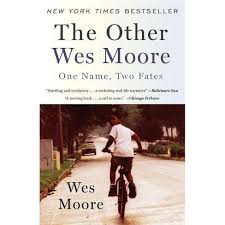
The author though is a much more conventional story line with the overcoming of struggle leading to significant success. At the beginning the two stories are very much running parallel but as they diverge the switching between the two Wes Moore’s becomes more and more of a stark and depressing comparison. It almost seems that when the author saw a moment of significant success, the other Wes Moore experienced another arrest or run-in with the cops. There are many specific events within the two Wes Moore stories that deserve to be read and as stated the juxtaposition of the two stories makes this book incredibly compelling. Reading the story of the other Wes Moore in moments highlights his potential which ended up under-utilized as a result of the path his life took. While the insinuation seems to be one in which the author could have ended down the path of the other Wes Moore and vice versa there is another conclusion that both could have ended up being successful. That to me was the most depressing conclusion of the book, that so much talent never gets/got to see its true potential as a result of so many obstacles that both Wes Moore’s describe having to face.
The authors closing remarks are perhaps the most indicative of what this book effectively teaches.
The chilling truth is that Wes’s story could have been mine; the tragedy is that my story could have been his. My only wish – and I know Wes feels the same – is that the boys (and girls) who come after us will know this freedom. It’s up to us, all of us, to make a way for them.
The precarious nature of life and how such small decisions can lead someone down a path are all exposed within The Other Wes Moore. The concluding ‘Call to Arms’ section hinges on this idea of a sense of humanity in providing more equal and equitable opportunities to those children who may be growing up in the same situation as the two Wes Moore’s. While sections may be depressing there is also hope and inspiration so this is not a book to avoid if it sounds like it will just be sad.
 The Weekly Book Report