
Mark Manson, The Subtle Art of Not Giving a F*ck (2016)
At this peculiar and potentially worrying time in history, I, like many others found myself with a significantly different routine. The pandemic has created a breeding ground for negative thoughts, emotions and consistent worry about the barrage of news and updates on the development of the crisis. On the opening flap to this incredibly popular book Manson notes, “Let’s be honest; sometimes things are fucked up and we have to live with it.” At this time blending a sense of realism with efforts to maintain some positivity has become a challenge for many.
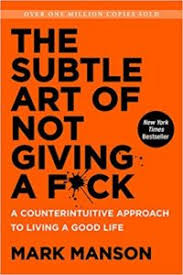
The subtitle, The Counter-intuitive Approach to Living a Good Life does sound great but the coarse language does little to make up for what largely becomes a repetitive message. However, I still find myself enjoying the refreshing writing style and even if the message is repetitive it still offers a lesson that is relevant in the current environment. I would summarize the main message as effectively suggesting only concerning yourself with the controllable elements of life.
Another insight offered is this process of reframing what is and what is not under your own control. The examples Manson offers are great stories in their own right often contrasting two in order to reach the lesson of that chapter. The example of Pete Best who missed out on being the drummer in the Beatles just before they achieved global fame, countered by Dave Mustaine who despite creating the metal band Megadeath was first kicked out of Metallica. The lesson Manson presents here concerns two individuals that both missed out on extraordinary global fame. While Mustaine did find considerable success with Megadeath he was never happy because he chose Metallica as the arbitrary comparison for success. Best on the other hand reoriented his values to family and continued to enjoy drumming around the world as well as a settled family.
Defining Good and Bad Values
Good values are 1) reality-based, 2) socially constructive and 3) immediate and controllable.
Bad values are 1) superstitious, 2) socially destructive, and 3) not immediate or controllable.
Honesty is a good value because it’s something you have complete control over, it reflects reality, and it benefits others (even if it’s sometimes unpleasant). Popularity, on the other hand, is a bad value.
Mark Manson, The Subtle Art of Not Giving a F*Ck
Manson continues through a number of different lessons with some that will undoubtedly being more relevant to some readers than others. I found that the separation of good and bad values underlies the other messages. This results in the previous suggestion that the book can become repetitive.
Another key takeaway that is actually fairly prevalent within similar inspiration/self-help/motivational books is that of becoming uncomfortable and going out of ones comfort zone. However, framed with Manson’s writing style and the more frank and upfront language it comes from a much less preachy perspective. Namely, it is best to be somewhat uncertain of yourself and that taking that first action is more important than starting motivated.
Certainty is the enemy of growth. Nothing is for certain until it has already happened – and even then, it’s still debatable. That’s why accepting the inevitable imperfections of our values is necessary for any growth to take place.
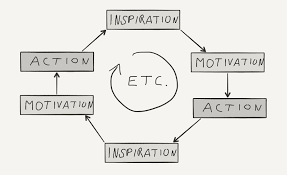
The thing about motivation is that it’s not only a three-part chain, but an endless loop:
Inspiration ->Motivation -> Action
The latter loop leads Manson to suggest the ‘do something‘ principle. If you lack motivation, he suggests taking action is the first step to generating a reaction that actually motivates you. This all then funnels back to the original message he promotes, that of not giving a fuck. Choosing to act, choosing not to act, choosing what to care about and choosing what not to care all require some element of not giving a fuck.
This impulse is shown to have two sides, one in which you do not care about others response if the action you wish to take is something you strongly believe in and you will not be stopped. The other, in not caring about things that are out of your control. The difference is somewhat subtle and this is why on the first read through the book was much more profound to me. Manson throughout all the lessons is therefore addressing a number of processes. It is also not teaching that not caring about anything is a positive. Instead, it is reorienting thoughts toward the controllable factors, it is steering away from a sense of exceptionalism and highlighting that everyone should be more selective about what they truly care about.
In my opinion, the success of the book is somewhat due to the move away from a constant narrative of positivity. It marks it as refreshing and while, it may, at points be jarring it ultimately still arrives at positive conclusions. Manson may spend time stating that not everyone is exceptional and not everyone will reach the same level of success, but what comes from this is actually the opposite suggestion with a caveat that everyone can be exceptional and succeed but it will be relative to themselves. To take it back to my favorite example. Mustaine considered himself a failure because his band Megadeath was not as successful as Metallica even though he still sold 10s of millions of records. Best on the other hand missed out on fame in the Beatles but considers himself successful having established a family and through finding peace in his situation can still enjoy playing music.
Not everyone is going to be successful and exceptional in the eyes of society but true satisfaction will come from inward contentment about not giving a fuck about that. As Best himself suggested “I’m happier than I would have been with the Beatles.”
This is all to say that despite the significant difference in form of Manson’s writing in comparison to other books of the genre this book still arrives at similar realizations. What he does achieve however, is a refreshing approach to arriving at said realizations. Furthermore, moving away from a sense of self-aggrandizing and exceptionalism helps his message stick. If any reader is ever interested in this type of book then this should be near the top of the list for the genre of motivation/inspiration/self-help. However, the book may not resonate with everyone. What is important is that when more people start to control what they can and stop giving a fuck about so many things then we may become happier, more content and generally better people. There are lessons that should be universally applicable and relatable and that is what gives this book its significance.
The desire for a more positive experience is itself a negative experience. And, paradoxically, the acceptance of one’s negative experience is itself a positive experience.
The current situation is difficult for so many but by abiding by guidelines and controlling the things one can control then some of the anxiety and fear can be diminished. The development of the epidemic is not something we can directly influence but by taking mitigation action we can help slow it down.
 The Weekly Book Report